How to get your AI coding agents to talk to each other
5 November 2026
Run one AI coding agent and you are the developer. Run four or five and you quietly become something else: the messenger.
One window needs to know what another decided. A reviewer needs to see what the builder changed. A bug turns up in one area and belongs to the agent working on another. None of them can reach each other, so all of it goes through you.
What being the messenger looks like
Naetive's founder, describing what changed once their agents could reach each other:
"I find myself not having to go to 4 or 5 windows and checking on them what the latest is and asking them to continue. Of course also not having to do the copy and pasting between agents."
Read it backwards and you have the job description. Visit each window, read where it got to, copy the important part, paste it somewhere else, explain it, and come back later to see whether anything happened. Your agents are fast. You are the slow part, and you are the only connection between them.
Why the usual workarounds break down
Copy and paste. It works for one message. But you carry the words without the reasoning behind them, and you have to be there for every single exchange.
A shared notes file. Agents write to it and are told to read it. In practice an agent reads it when it thinks to, which is usually the start of a session. A note left mid-task sits there until someone points at it.
One agent summarising for another. The summary is only as good as what the first agent thought mattered. The second agent cannot ask a follow-up, so it guesses.
All three have the same weakness. The agents still cannot address each other. You are still the route.
Agents that ask each other directly
In Naetive, each agent has a name, and the name is its address. One agent asks another for a review, a question or a handoff, and the answer finds its way back without you. Claude Code agents are woken when an answer arrives; ChatGPT and Codex pick it up on their next step.
Ask, hand off, report. Ask a question, hand work to another agent, or report a bug to the agent that has to fix it. Only the agent that found the bug can close it as fixed.
Reviews with a verdict. A reviewer answers approved, approved with notes, changes required or rejected. An approval can come with conditions, and each one is checked off only when a commit closes it or the reviewer has seen it met.
It all sits on the shared understanding. The agents are not just passing messages. They work from the same living understanding of the project, so a question arrives with the context it needs, and what gets decided is recorded for every agent after.
You stay in charge, without the legwork
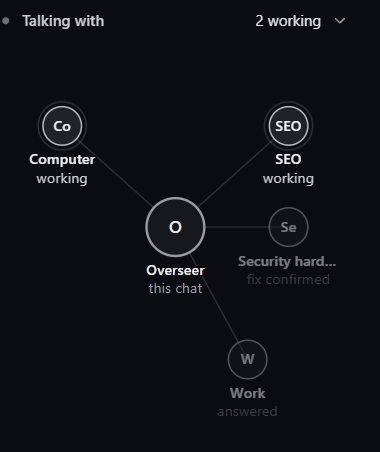
Taking you out of the relay does not take you out of the loop. Work shows what every agent asked every other one, with what needs you first and how long each has waited. Each chat also shows who it is talking with right now, and marks the conversation that is waiting on you.
So the question changes. It is no longer "what is every window doing, and who needs to know?" It is "what needs me?" Usually the answer is one thing, not five windows.
Getting started
Connect your agents to one project, give each one a name, and let them ask each other. Here is how to connect Claude Code, Codex, ChatGPT and Claude. If you have been running several agents and doing the relaying yourself, the first review that comes back without you carrying it is the moment it clicks.